

'Incarnating That Ghost:' Reflecting on Marriage, Nature, and That Hideous Strength
I just finished reading C. S. Lewis's 1945 sci-fi and am pondering its unexpected theme of marriage.

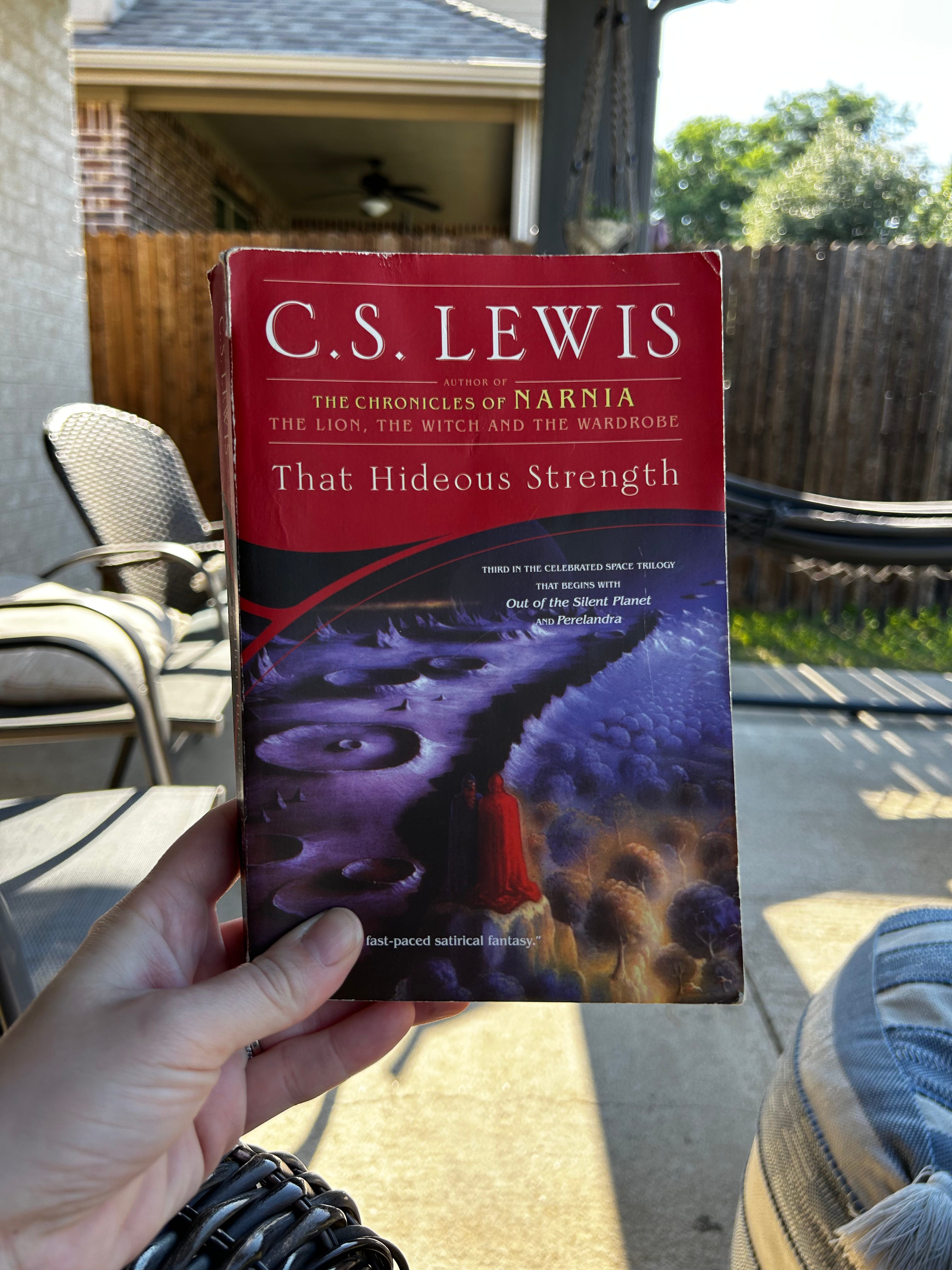
Last night I finished That Hideous Strength. I expected it to be about artificial intelligence; that’s how it was billed to me by more than one person. And on that front, it did not disappoint. What I didn’t expect was the preeminent theme of marriage, which began and ended the story.
*For those who have never read That Hideous Strength, there may be mild spoilers ahead, mostly regarding character arcs, not major plot points.*
Jane and Mark, the two main characters who are married to each other, spend very little time in the book together as events take them on divergent journeys. This works well for the plot, since their respective adventures bring the reader into the inner circle of the two opposing forces of the whole story.
What annoyed me, I’ll admit, is when another main character focused on Jane’s apparently wrong attitudes toward Mark. (That annoyed Jane as well.) I tried to ignore what I took to be the slightly antiquated assumptions on wifehood that C. S. Lewis, still unmarried at the time he published THS, held. Get on with the sci-fi stuff, the supernatural stuff, the action, my brain said. Leave Jane’s attitude toward her loser husband alone.
Color me—and Jane—humbled.
Vice Queen
Over the course of the story, Jane realizes (with resistance, at first) that she had been too jealous for her own “freedom” to give herself fully to love and family.
Even more slowly, Mark realizes he has always been self-focused and self-serving, obsessed with his image, never able to rest in who he is. He made everyone a means to his own ends and broke his moral compass by constantly trying to fit in. He had done the same with Jane. He had used her and taken her for granted.
Both Jane and Mark expressed self-worship of a kind, and by the end, they’re both humbled and ready to serve, to play the part they owe reality and their marriage.
Gratified as I was that Jane didn’t get the short end of the stick after all and that Mark got his own realizations as well, I still wondered…why end this fascinating, creepy, enthralling sci-fi/supernatural thriller on this note of marriage? Not that I don’t love marriage in general and appreciate an artful romantic streak in a story…but surely this wasn’t the point of this story?
Journaling always helps. And as I journaled and thought, I realized that Jane and Mark’s root sin, though expressed slightly differently, was the same sin expressed by the N.I.C.E. (those are the bad guys). It was the same sin expressed at Babel. It is the queen of vices, after all.
It is pride. And it is the point.
Pride is the Point
At Babel, at Belbury (where the N.I.C.E. was headquartered), and in Mark and Jane’s lives, pride fooled people into thinking they could rebuild themselves on their own terms. In that way, pride is the undoing of the natural world and the natural order God has given us—from belief in the supernatural to organic life to affection to sex itself. Pride is replacing all those “outdated” things with something we think we can control.
For example, here is Professor Filostrato of That Hideous Strength, saying what many are essentially saying today:
We do not want the world any longer furred over with organic life … we must get rid of it. By little and little, of course. Slowly we learn how. Learn how to make our brains live with less and less body … Learn how to reproduce ourselves without copulation.
Just for comparison, here are a couple quotes from real-life, modern day folks:
“I assume my brain will be uploaded to the cloud.” — Sam Altman, OpenAI CEO
“Sex is for fun…embryo screening is for babies.” — Noor Siddiqui, CEO of Orchid
The AI Connection
Finally getting the point about pride, I recalled a quote from Paul Kingsnorth’s Against the Machine that has stuck with me since I read it last fall: “We seek, openly now, to become the gods we always wanted to be, using technology as the force which will get us there.”
We want life and reality on our own terms. It’s not that scientific “progress”—whether in Lewis’s fictionalized England or in real life today—brings about this human desire to be like God, or to be gods ourselves. That desire has always been there from the moment Eve reached for the forbidden fruit.
Now as then, we want a life free of the moral order inherent in the universe, free of the dependence inherent in human relationships. Ironically, when we achieve this man-made “freedom,” we are trapped in man-made hells, as Jane and Mark and many other characters in That Hideous Strength discover through varying degrees of violence and redemption.
I believe large language models (LLMs) play into this selfish, prideful desire of ours, often without people even realizing it. They do this by deceptively building trust, all the time pulling humans away from the real interactions and relationships we need, and the kind of thought life and even struggle required to truly gain understanding. They convince us we don’t need the other people or the mental struggle. They deceive us into thinking we can “hack” life and gain knowledge or companionship on our own terms without the mess of friction.
Heck, it was happening before LLMs. Technology holds us mesmerized with all its capabilities, which become our capabilities, as long as we stay attached (enslaved?) to the “tool.” Meanwhile, the human race is dying. See: a new paper suggesting the ubiquity of the iPhone may have played a significant role in driving down fertility rates.
It seems the technologies we’ve developed in the name of progress are actually causing (or contributing to) regress, pulling us away from the things that make us human. But like Frost, an appropriately named character in THS, many people remain too stubborn in their pride to realize just how inhuman they’ve become.
Incarnating That Ghost
I loved Cecil Dimble’s quote toward the end of the book:
The whole work of healing Tellus [Earth] depends on nursing that little spark, on incarnating that ghost, which is still alive in every real people, and different in each.
—Cecil Dimble, That Hideous Strength
Fighting for that “ghost” or soul in human communities is not just the domain of dazzling planets and spiritual beings. The battle for the ghost of the people must be fought by us in the places from which we often think we want liberation—in stable homes, in faithful marriages, in family loyalty, in friendships that actually demand something from you, in dusty pubs and little gardens and natural life.
There’s a scene early on in the book where Mark and a colleague scout Cure Hardy, an idyllic village destined for destruction. It is one of my favorite scenes because Mark’s all-but-forgotten sensibilities can’t help spilling over and revealing the value of such places, despite his efforts to squash those sensibilities. They stand in stark contrast to his colleague, who has successfully squashed his own sensibilities.
First, it was the countryside of the remote village itself:
“How nice it is!” said Mark to himself next morning as the car left the main road at Duke’s Eaton and began descending the bumpy little lane into the long valley where Cure Hardy lay. … Every little copse was black and bristling as a hairbrush, and when the car stopped in Cure Hardy itself the silence that followed the turning off of the engine was filled with the noise of rooks that seemed to be calling “Wake! Wake!”
“Bloody awful noise those birds make,” said Cosser.
Then, the place in the village where ordinary people congregate to talk, relate, and be human:
In the Two Bells it was very warm and dark, for the window was small. Two labourers (no doubt recalcitrant and backward) were sitting with earthenware mugs at their elbows, munching very thick sandwiches, and a third was standing up at the counter conducting a conversation with the landlord.
“No beer for me, thanks,” said Cosser, “and we don’t want to muck about here too long. What were you saying?”
“I was saying that on a fine morning there is something rather attractive about a place like this, in spite of all its obvious absurdities.”
“Yes, it is a fine morning. Makes a real difference to one’s health, a bit of sunlight.”
“I was thinking of the place.”
“You mean this?” said Cosser glancing around the room. “I should have thought it was just the sort of thing we wanted to get rid of. No sunlight, no ventilation. Haven’t much use for alcohol myself…but if people have got to have their stimulants, I’d like to see them administered in a more hygienic way.”
“I don’t know that the stimulant is quite the whole point,” said Mark, looking at his beer. The whole scene was reminding him of drinks and talks long ago—of laughter and arguments in undergraduate days. Somehow one had made friends more easily then.
Rebelling Against the Rebellion
Back to the theme of marriage, which ties the bow at the end of the book and hopefully to this late-night reflection. I think marriage ties the bow because it is that ultimate human relationship, the one which the Bible says represents the most sacrificial kind of love we can imagine. It’s the very relationship that, when it splinters and fails, sends whole families and societies and civilizations into decay. I think there is a literal reason Lewis focuses on it.
But symbolically in the book, I think it also represents God’s created, natural order that our pride kicks and screams against. Which is why, as I shelve the third novel in Lewis’s 1940s space trilogy, my primary takeaway is that rejoicing in nature, reveling in the creation which God called good, not ever imagining oneself above the inefficiently sacrificial relationships that make us human, is itself a rebellion against “that hideous strength.”